Case · Construction

Nowa Bud: a property sales website in four languages.

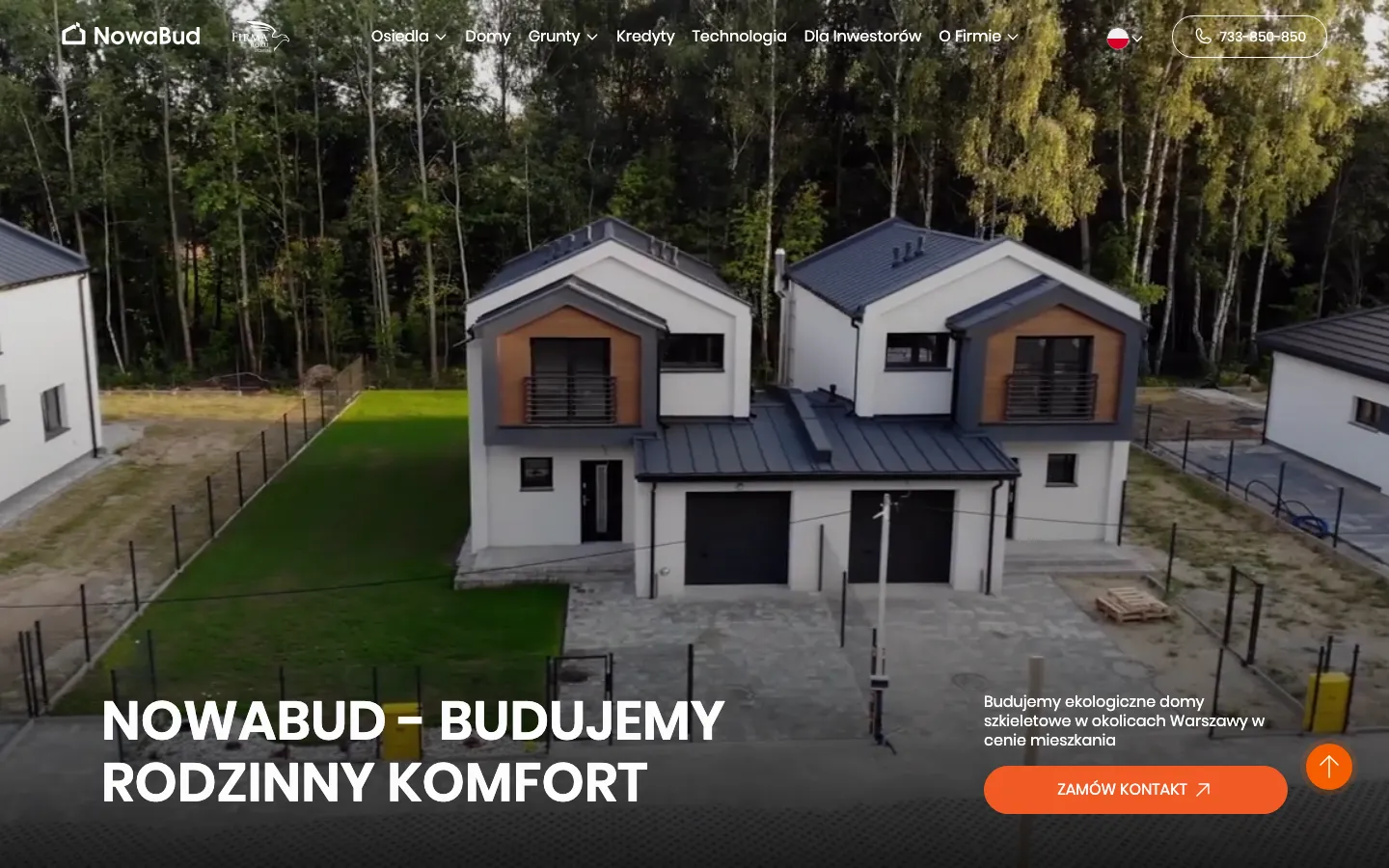
Nowa Bud builds timber-frame houses on estates around Warsaw. The brief was blunt: follow the brandbook, skip the decorative animation, and make a very large amount of information easy to move through for buyers who speak Polish, English, Ukrainian or German. Webflow, four languages, edited by the client.

  • Construction
  • Real estate
  • Webflow
  • PL · EN · UK · DE
  • Warsaw, Poland
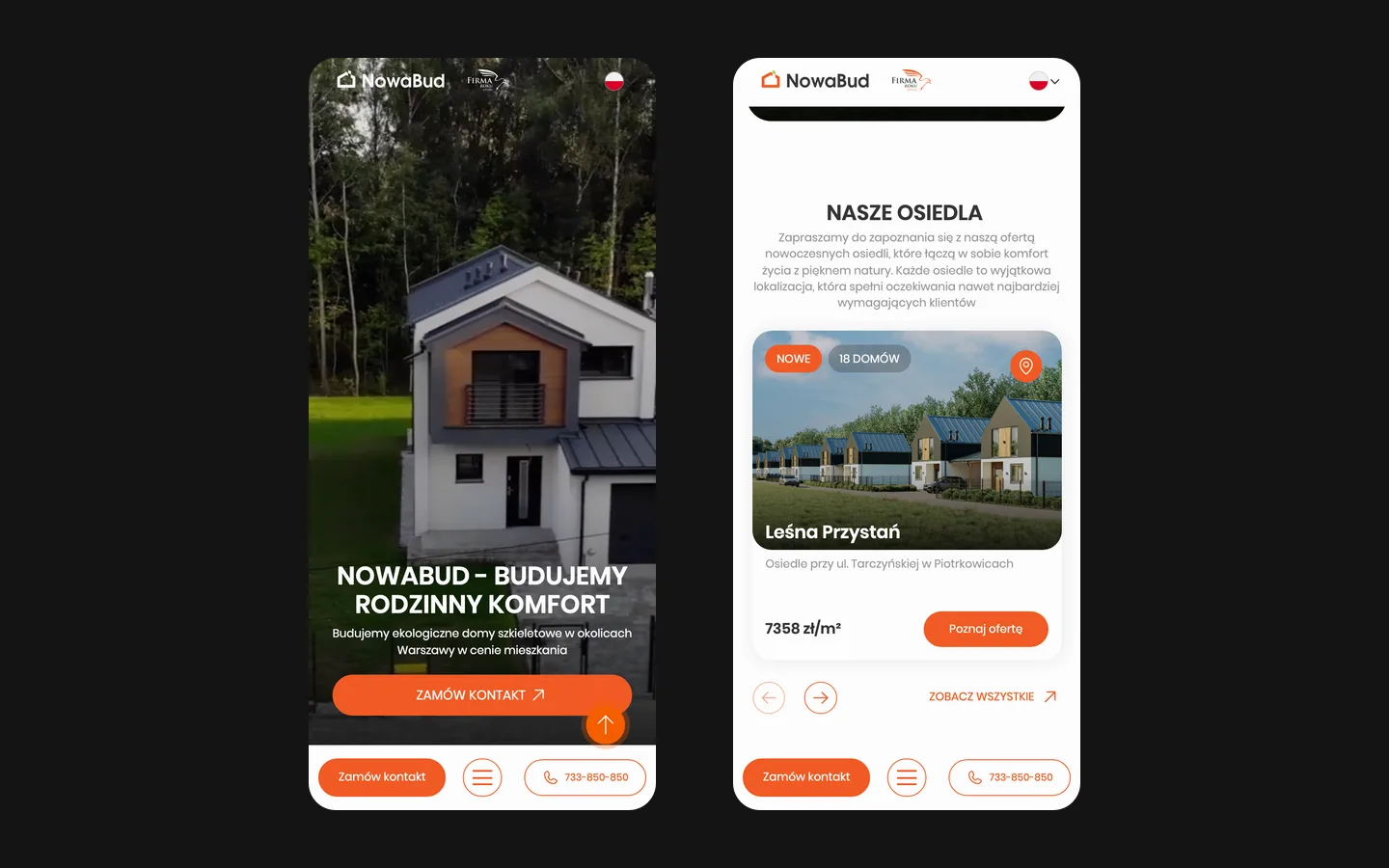
nowa-bud.plNowa Bud website preview
4 languages

Polish, English, Ukrainian and German, with correct language tags for search engines. checked on the live site · Sep 2026

Built on Webflow

Estates, houses and plots are collections the sales team edits. checked on the live site · Sep 2026

Estates, houses, plots, investors

Four ways in, one structure, built like a well-run sales office.

The project

Task, approach and delivery

The task

Nowa Bud builds timber-frame homes year-round on estates around Warsaw and across Mazovia. Buyers in this belt are not only Polish, so the site had to work in four languages from the start.

The brief was blunt: follow the brandbook, skip the decorative animation, and make a very large amount of information easy to move through: estates, individual houses, available plots, the construction technology explained for people who have never heard of timber frame, and a separate track for investors.

The approach

We structured the site like a well-run sales office: estates first, then houses, plots and technology, with a separate path for investors who read differently from families.

Plans of every settlement are on the site, and the pricing block reads from the client’s own spreadsheet, so a change in one cell updates the page without a developer.

What we delivered

An information-heavy sales site on Webflow in four languages that the client has run on their own since launch. Domain and hosting in the client’s name.

Several developments, four languages and a clear route to a property

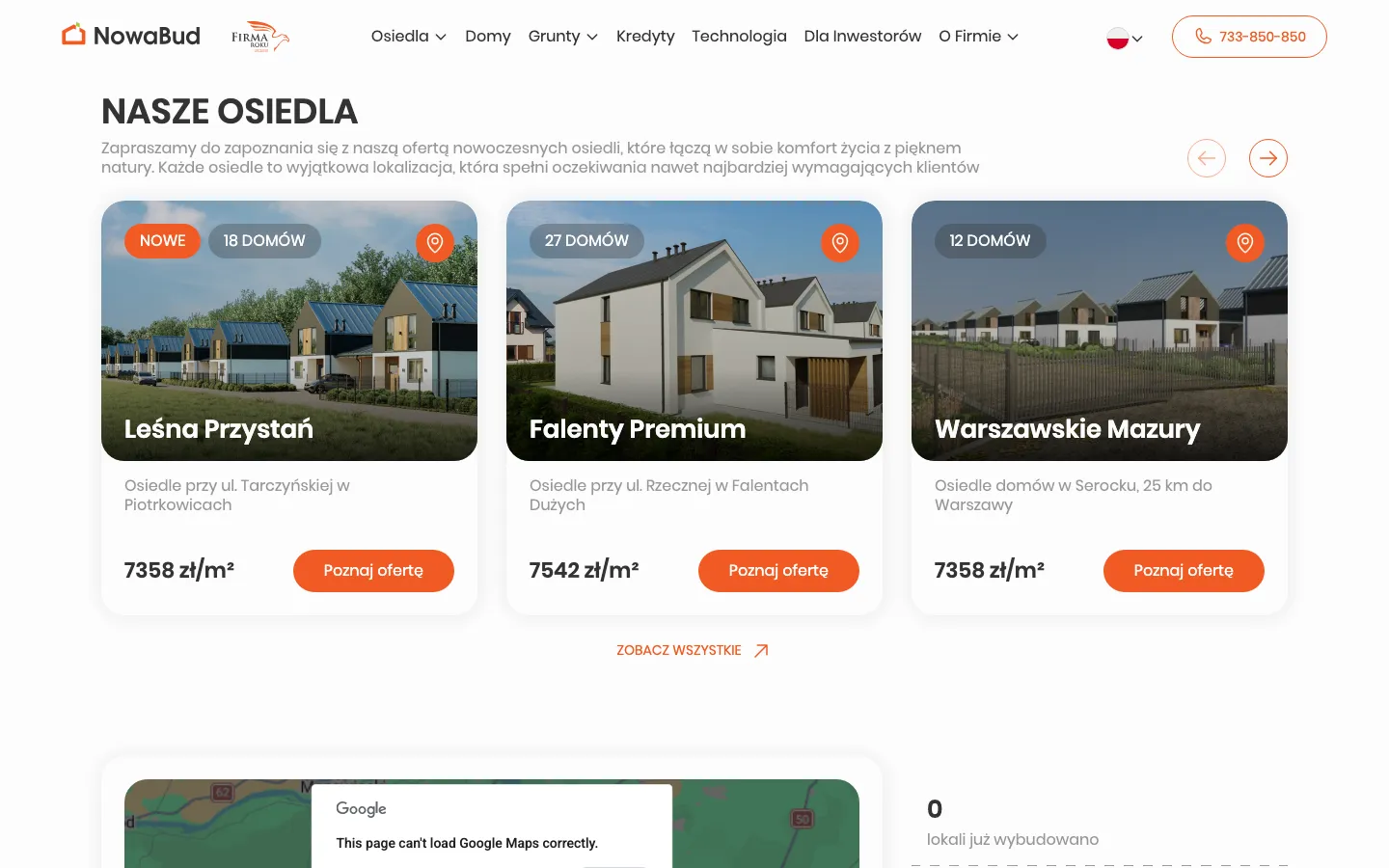
The difficult part of this project was the amount of information behind the offer. Nowa Bud needed to present residential developments, house designs, plots and a separate proposition for investors. Visitors arrive with different decisions to make: buy a home, build on land they already own or discuss an investment. The website gives each of these intentions a useful starting point before the sales conversation.

The catalogue starts with the buyer’s question

A development, a house design and a plot are connected, but they are different starting points. A family that has chosen an area wants to understand the location and surroundings. Someone who owns land needs to evaluate the house and the possibility of building it there. An investor needs the appropriate commercial discussion. A single uninterrupted showcase would leave each visitor to separate relevant information from someone else’s buying journey.

The Nowa Bud structure provides separate entrances to these parts of the offer. A property can be understood in context: where it belongs, what information describes it and where the visitor can go next. This matters particularly when someone receives a link to an internal page and never sees the homepage. A useful detail page should explain the subject without requiring the reader to restart their visit.

For a similar commission, we first map the entities and their relationships. One house design may appear in several locations; a plot belongs to a particular place; availability changes independently of the construction method. Separating these concepts helps determine what belongs in the catalogue, what each listing needs to show and which explanations can be shared across the site.

Design decisions connected to the sales task

Working within an existing identity
Nowa Bud already had a brandbook. The work therefore centred on the established identity and on organising information. The restrained presentation gives plans and property details room to remain the main content. For another company, the initial review should establish which brand decisions are actually documented: a logo alone does not define a consistent catalogue, form system and set of translated pages.
Plans alongside imagery
The project includes development plans. Images introduce the character of a place, while a plan answers spatial questions. Both need to remain legible at a useful size. In a new catalogue we would discuss image scale, labels and the route from an overview to a particular property, including how this works on a small phone screen.
Explaining the building method
Timber-frame construction has its own explanation within the site. A prospective buyer may be encountering this method for the first time. Clear content should help them prepare questions and compare the scope of an offer. The construction company must confirm specifications, warranties and inclusions; the design team should never invent stronger promises to make a page sound persuasive.

Four languages mean four usable versions of the offer

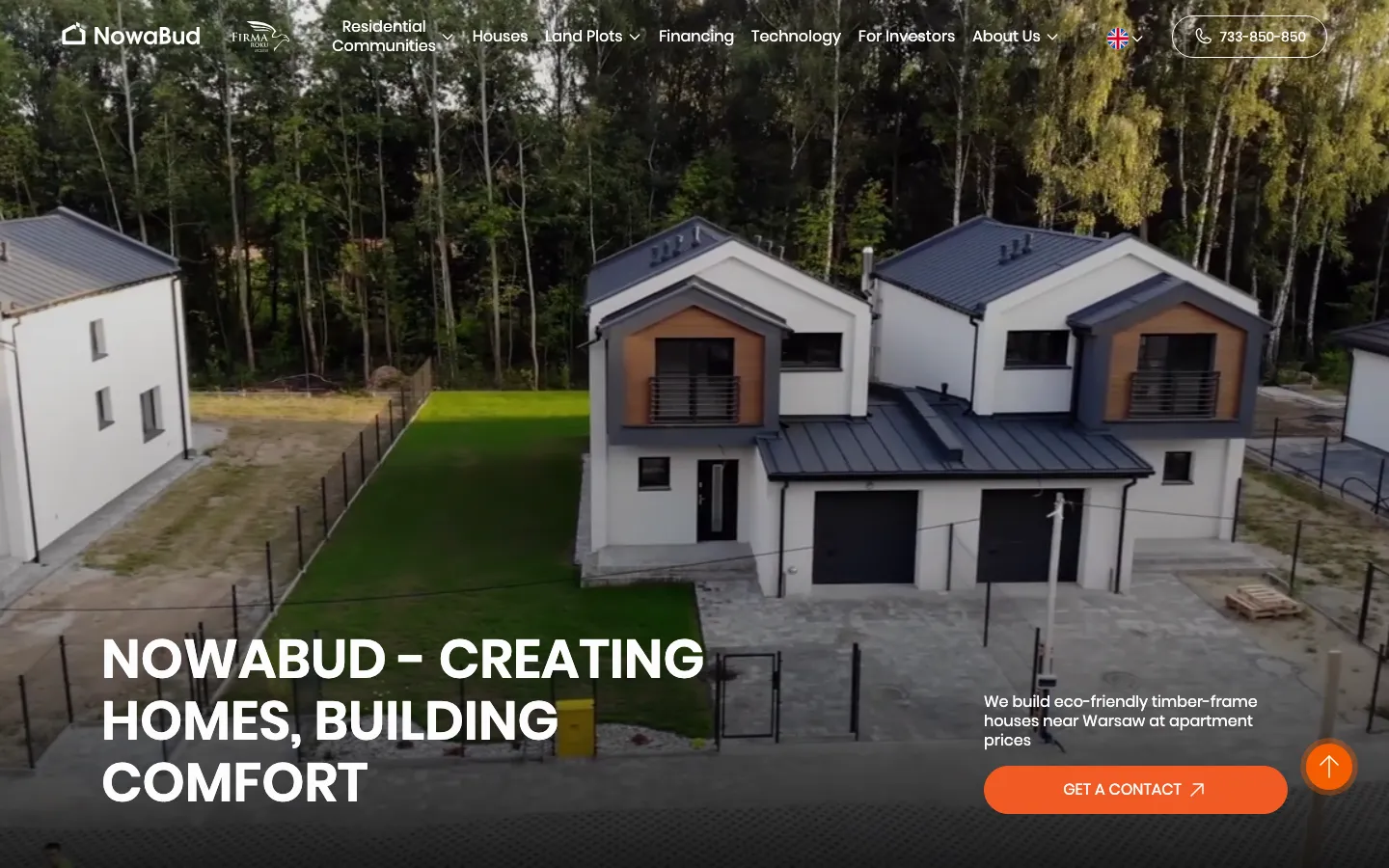
Nowa Bud is presented in Polish, English, Ukrainian and German. Translation is useful when the visitor can understand the property information and the next step in their language, as well as the navigation. This affects the catalogue structure from the beginning: the same property needs to remain identifiable even when names, explanations and sentence lengths differ.

A property page is also something people share with family members and advisers. They expect a language change to preserve the subject they were discussing. A useful acceptance check for a new website follows the entire path: open an internal page, change language, return and share the link. Sending someone to the homepage instead of the equivalent page interrupts that journey. Plan labels, form instructions, buttons and submission messages need their own language checks.

Translations also need an owner after launch. A change to floor area, specification or the offer should be checked against the same current source in every language. Language annotations help search engines connect equivalent pages; they do not verify the translation or guarantee rankings. An ongoing content process therefore matters alongside the technical implementation of language switching.

Price updates need a clear source and an owner

In the documented solution, the price block reads from the client’s spreadsheet. The sales team can maintain that source in a familiar working format. This connection is useful when numbers change more often than the page layout. It also makes the meaning of each field important: an individual property price, a price per unit of area and a starting price are different pieces of information.

For a comparable integration, we agree who edits the source, which rows may be published, how each row identifies a property and what happens when a value is missing. An empty cell should not silently become a zero price. Those behaviours can be checked with test data before a real offer goes live. These are requirements to discuss for a new implementation, rather than a claim that every mechanism listed here was separately built in this project.

Editable Webflow collections let the client maintain the catalogue content. A useful handover for this type of site walks through an ordinary operation from beginning to end: change an entry, replace a visual, check the affected languages and inspect the published result. Having access to the publish button is only part of being able to maintain the offer confidently.

What to prepare for a similar website

  1. Map the offer

    List the developments, house designs, plots and separate partnership opportunities. Show which records relate to one another and which are ready for publication. Real sample entries are more useful at this stage than an arbitrary screen count. A few complete examples often reveal differences that will affect the catalogue template.

  2. Collect materials and update rules

    Prepare the brandbook, licensed photography or visualisations, plans, verified specifications and the price source. Name the launch languages and the person who approves translations. Identify information that changes frequently so we can distinguish stable content, editable fields and values supplied by another system.

  3. Define the first conversation

    Decide whether a visitor should request a callback, arrange a meeting or ask about a specific property. Identify the recipient and the information genuinely needed to answer. During scoping, we connect this action to the page the visitor has been reading so that the enquiry continues the decision rather than asking them to explain everything again.

What the project demonstrates

Nowa Bud demonstrates work on an information-heavy construction website: an existing brand identity, several types of offer, four languages, editable collections and spreadsheet-supplied prices. Each of those decisions can be assessed against a different business. A contractor offering one service may need a much simpler structure than a developer maintaining multiple catalogues.

This case does not contain verified figures for enquiry growth or property sales, so we do not attribute such results to the design. For a new website, measurement is a separate responsibility: which properties are viewed, where enquiries begin and which enquiries develop into useful conversations. Send your offer structure and a sample listing to discuss a comparable project. Those materials allow a more grounded scope and estimate than a page count alone.

What the site does

Project features

  • Four languages

    Polish, English, Ukrainian and German, each its own pages with the right tags.

  • Estates, houses, plots

    Three catalogues with one structure; a buyer picks the way in.

  • Technology explained

    Timber frame for people who have never heard of it, in plain words.

  • A track for investors

    A separate path with the facts an investor reads first.

  • Prices from a spreadsheet

    The pricing block reads the sales team’s own file; one edit updates the site.

  • Edited by the client

    Collections in Webflow; no developer since launch.

“They built the site for our construction company. Straight to the point: they helped and advised wherever it was needed. Thanks for the work, I recommend them.”
Nowa Bud · Construction · translated from the original

OriginalРобили нам сайт для будівельної компанії. Усе по ділу — допомогли, підказали, де треба. Дякую за роботу, рекомендую.

Questions

About Nowa Bud

Which languages does the Nowa Bud site have?

Polish, English, Ukrainian and German, each as separate pages with correct language tags, as checked on the live site in September 2026.

What is the Nowa Bud site built on?

Webflow, following the client’s existing brandbook. Estates, houses and plots are collections the sales team edits without a developer.

How are prices kept current on the Nowa Bud site?

The pricing block reads from the client’s own spreadsheet, so when the sales team edits a column the site updates itself.

Start a similar project.

Tell us what your site has to do. A short call, then a fixed price in writing.